New press release live from UNOC: Read here


An alert from Global Mangrove Watch flags a rapid loss of mangroves along the Rakhine coastline in Myanmar. Old growth mangrove forest is being actively cleared. While on the ground only few people can witness this change, from space the destruction is visible to everyone.
This is the challenge of mangrove conservation today. These powerful blue carbon ecosystems, vital infrastructure for resilience, livelihoods, and biodiversity, often vanish far from view, beyond the reach of routine monitoring. But there is a simple truth behind any successful conservation effort: you can’t save what you can’t see.
Across many countries, mangroves disappear out of sight, far from capital cities, beyond the day-to-day view of park managers and local authorities. And often outside the monitoring capacity of governments that don’t yet have a dedicated national system for tracking mangrove change. Decision-makers are therefore often forced to rely on outdated inventories, patchy field surveys, or anecdotal reports. Lack of mangrove data also limits financial institutions’ ability to assess their interdependencies and risks linked to these vital ecosystems. Altogether, the lack of mangrove data is a recipe for delayed action, misplaced investments, and missed opportunities.
This is where mapping, especially from satellites, has become a game changer for mangrove conservation and restoration.
Cutting-edge satellite data enables translation of goals into decisions on the ground
Fortunately, some global tools already exist to bridge this gap. The Global Mangrove Watch (GMW) provides near real-time data on mangrove forests globally. With the GMW platform, countries and practitioners can monitor vast, difficult-to-access coastlines regularly and consistently. GMW provides free, easy-to-use annual maps of mangrove extent, loss, and gain for all countries generated using optical and radar satellite data.
For policymakers, land managers, researchers, and conservation practitioners, such reliable mangrove data is invaluable. A coastal planner can compare districts. A community organization can validate what they’re witnessing on the ground. Governments can see where loss is happening in near real-time—not two years from now.

Just as importantly, GMW can help countries integrate mangrove-positive commitments into their national climate, biodiversity and development plans and translate these targets into priorities and investment ready opportunities on the ground:
Built on open, state-of-the-art science and continuously refined data, GMW provides countries with the credible baselines needed for progress tracking and results reporting. This data supports everything from greenhouse gas and national wetlands inventories to reporting for major international mandates, including the Paris Agreement, the Global Biodiversity Framework, and the Ramsar Strategic Plan 2025–2034.
2026 will see the 4th revision of the Global Mangrove Watch extent and change maps with improved accuracy and with data spanning from 1985 through 2025. This ensures that coastal managers, project developers, local groups and financial institutions have the precise and updated data needed to prioritize, plan, finance and monitor conservation and restoration activities effectively, even in remote areas beyond the reach of routine surveillance.
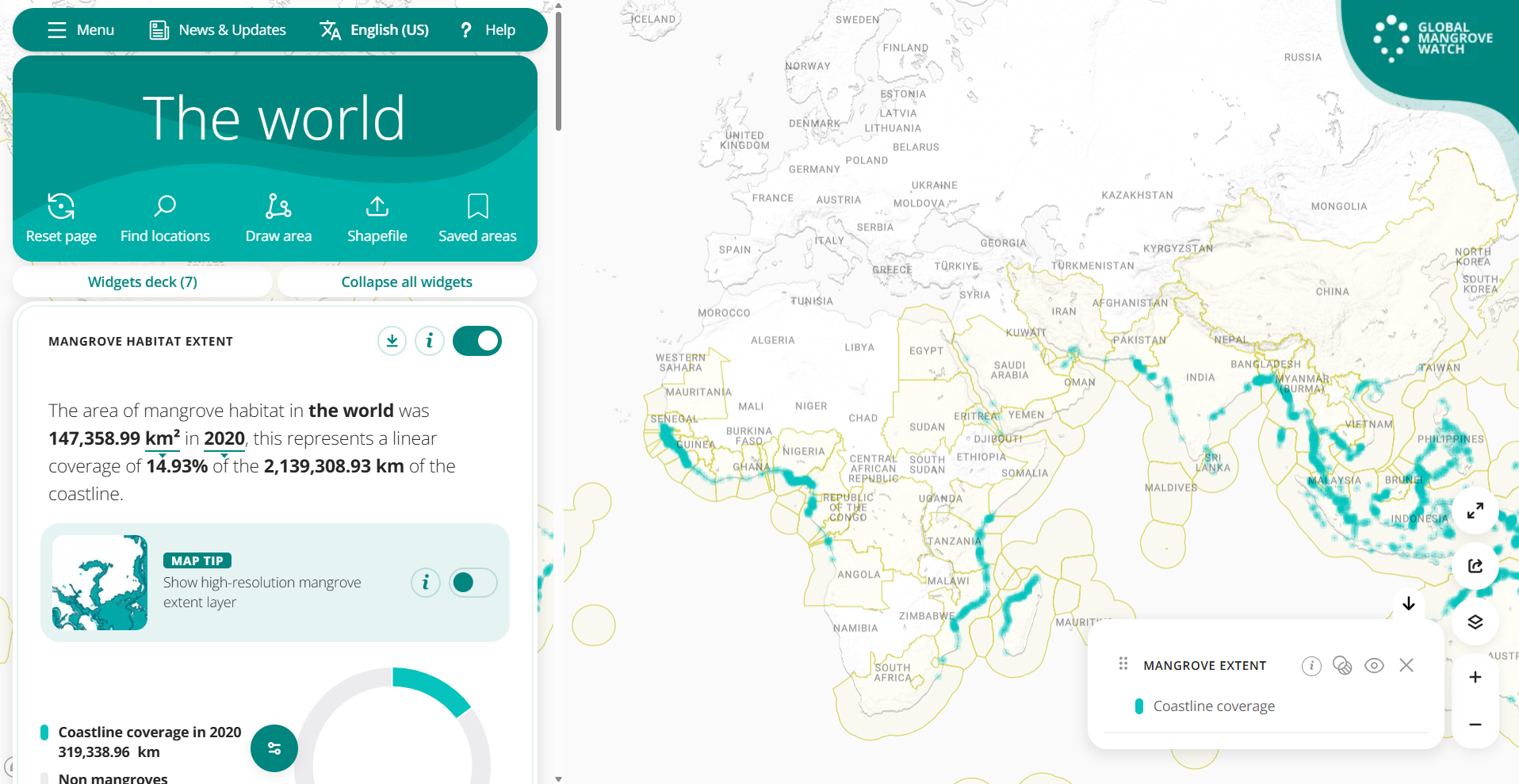
A shared baseline for a global shift in mangrove protection, restoration and finance.
And it’s exactly this information that underpins the Mangrove Breakthrough, a global call for action to mobilize $4 billion by 2030 to secure the future of 15 million hectares of mangroves by 1) halting mangrove loss, 2) restoring half of what has been lost, and 3) double the area protected, backed by governments and partners across civil society, research, and finance.
Bold targets require a credible plan to translate global ambition into local action: where to protect, where to restore, what the benefits are. The GMW provides the shared baseline and monitoring system for the Mangrove Breakthrough, providing the most up-to-date information on mangroves, giving governments, funders, and communities a common picture of where change is happening, where interventions are needed and whether these are working.
Using GMW spatial data, the Mangrove Breakthrough has calculated regional and national targets for each of its global goals. These are available through the Regional Readiness reports for Asia, Americas and West Africa alongside supplementary national summaries for several focus countries that outline country-specific enabling conditions and priorities for mangrove action.

Mangrove restoration potential in Asia, Mobilizing the Mangrove Breakthrough Regional Readiness Report
With its consistent mapping approach, GMW also enables transparency —supporting year-by-year progress tracking, comparisons across countries and regions, and clear accountability to funders and communities.
The Mangrove Breakthrough is setting the stage for a transformational shift in how mangroves are protected, restored and financed, combining cutting-edge scientific data, implementation guidance such as for successful mangrove restoration, financial mobilization, and global collaboration.
From mapping mangroves to financing restoration
Leveraging the Global Mangrove Watch data, the Mangrove Breakthrough has teamed up with Restor to map mangrove projects worldwide, already capturing hundreds of projects and their impacts. By consolidating key information on biodiversity, financing approaches, and business models, the platform helps elevate high-quality mangrove opportunities to funders and investors. In doing so, it helps bridge the gap between mangrove positive action and accessible finance, while enabling fund managers to identify credible projects and assess the environmental impact of their portfolios.
Key resources:
The Global Mangrove Watch (GMW) was established in 2011 under the Japan Aerospace Exploration Agency’s (JAXA) Kyoto & Carbon Initiative with the aim to provide open access geospatial information about mangrove extent and changes to the Ramsar Convention on Wetlands. Today, The Nature Conservancy, Wetlands International, Aberystwyth University, and soloEO host and develop the Global Mangrove Watch Platform to support mangrove conservation and restoration worldwide.
.jpg)