New press release live from UNOC: Read here


The Mangrove Breakthrough, in partnership with Magnitude Global Finance, has released a new series of practical Mangrove Finance Handbooks designed to help financial institutions, microfinance organizations, and project developers unlock the full potential of mangrove-positive investment.
These how-to guides distill months of research, fieldwork, and insights gathered through workshops in Colombia, the Philippines, and Senegal, complemented by real-world Mangrove-Positive Lending Case Studies. Together, they offer a clear, accessible roadmap for scaling finance toward the protection, restoration, and sustainable use of mangrove ecosystems.
Update February 11th, 2026: The Mangrove Finance Handbooks are now available in Spanish, Portuguese, and Bahasa Indonesian.
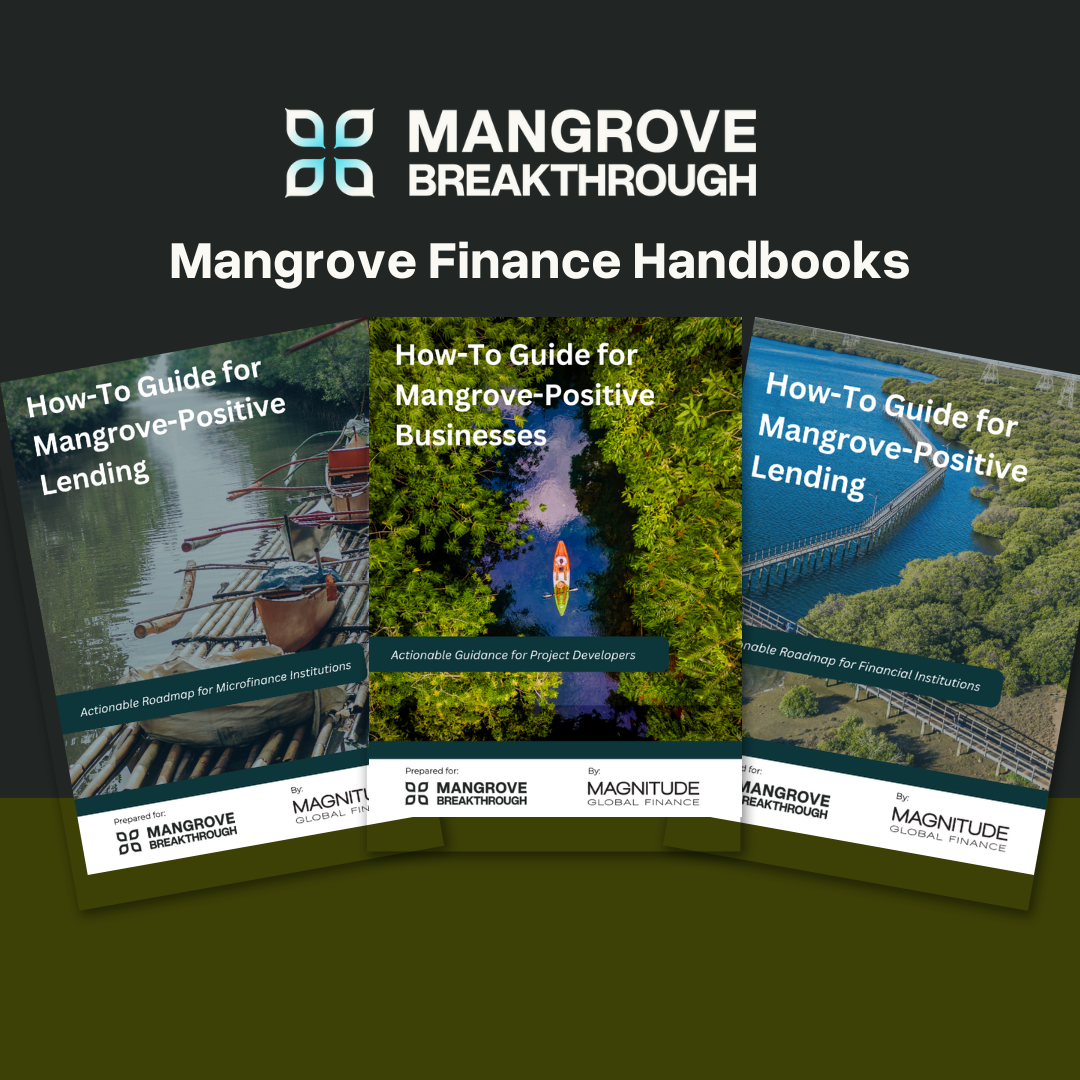
This roadmap provides microfinance institutions (MFIs) with an actionable pathway to develop and implement mangrove-positive lending approaches. The document addresses the critical need to mobilize financial resources for mangrove conservation, restoration, and sustainable use at the household and microenterprise level as part of a broader effort to mobilize finance for mangroves.
Read it here.
This report provides financial institutions with a practical roadmap for developing mangrove-positive lending approaches that contribute to achieving the Mangrove Breakthrough’s targets, reducing physical risks to assets, and unlocking the wide range of business opportunities that mangroves present. By guiding financial institutions through a systematic approach to mangrove-positive lending, this roadmap enables institutions to generate revenue, manage risk, and access new markets while directly supporting the conservation and restoration of these critical coastal ecosystems.
Financial institutions that implement mangrove-positive lending approaches position themselves to capitalize on emerging regulatory requirements, growing international capital flows, and increasing client demand for sustainable financing solutions, all while contributing to the protection of one of the world's most valuable and threatened ecosystems.
Read it here.
Coastal development projects worldwide face mounting pressure from climate change, regulatory requirements, and investor demands for sustainability. For developers in coastal areas with mangrove ecosystems, healthy mangroves can be an important risk mitigation and revenue generation opportunity. By ensuring a do-no-harm approach and meaningfully contributing to the conservation and or restoration of nearby mangroves, projects can benefit from physical risk reduction, government and civil society support, and, potentially, access impact-seeking capital. This practical guidance helps developers add a mangrove-positive lens to their projects, benefit from proximity to healthy mangroves, and align with emerging guidance for mangrove-positive lending that could lower their capital costs.
Read it here.
Read it here.

.jpg)